
Lead-to-booked-call rate: how to measure it and raise it
If leads come in but calls do not get booked, the problem is usually between the form and the calendar. Here is how to measure that step and the levers that move it.
By Steven Spencer, Founder & CEO, Spencer Digital · Published · Last updated · 8 min read
Lead-to-booked-call rate is the share of new leads who book a sales or strategy call within a set window. To measure it, divide booked calls by new leads from the same period and source. To raise it, reply faster, make the form and booking step simpler, and follow up on a clear schedule.
For any business that sells through a call, this is one of the most useful numbers you can track. It sits between marketing and sales, so it often gets ignored by both. Ads can be producing plenty of leads while revenue stays flat, simply because too few of those leads ever reach the calendar. This guide covers how to calculate the rate honestly, how to find where leads drop off and the practical levers that raise it.
What is lead-to-booked-call rate?
It is a stage-to-stage conversion rate. A lead is someone who has given you their details, for example through a website form, an ad lead form or an inbound message. A booked call is a confirmed appointment on the calendar with a person who can help them buy. The rate tells you how well your business turns interest into a real conversation.
It is different from your show rate (booked calls that actually happen) and your close rate (calls that become customers). Keeping the three separate matters, because each one has different causes and different fixes. If you blend them together, you cannot tell whether the problem is your follow-up, your reminders or your offer.
How do you calculate it honestly?
The basic formula is simple:
Lead-to-booked-call rate = booked calls from a group of leads ÷ the number of leads in that group × 100
The hard part is making sure the two numbers describe the same people. A few rules keep the figure honest:
- Use cohorts, not calendar totals. Count the leads that arrived in a period, then count how many of those same leads booked. Comparing this week’s bookings with this week’s leads mixes in people who signed up weeks ago.
- Pick a booking window and keep it. For example, a lead counts as booked if they book within 14 days of arriving. Write the window down so the number means the same thing every month.
- Remove duplicates, tests and spam. One person who fills in two forms is one lead. Internal test submissions and junk entries should not count in either number.
- Count booked, not held. A no-show still counts as booked here. It shows up later in your show rate, which keeps each problem in its own place.
- Split by source. Calculate the rate for each campaign, ad set or lead source as well as overall. An average can hide one source that books well and another that rarely does.
All of this depends on every lead keeping its source and moving through clear stages. If your CRM is not set up that way yet, start with our guide to CRM pipeline stages for high-ticket sales.
Why does this rate matter more than cost per lead?
Cost per lead only tells you what you paid for a name and an email address. It says nothing about whether that person ever spoke to you. A campaign with cheap leads that rarely book can cost more per booked call than a campaign with expensive leads that book often.
That is why it helps to divide ad spend by booked calls, not just by leads. When you know your cost per booked call for each source, you can move budget toward the ads that create real conversations. If your ads look fine on cost per lead but sales are flat, the problem is often after the click rather than in the ad.
How do you find where leads drop off?
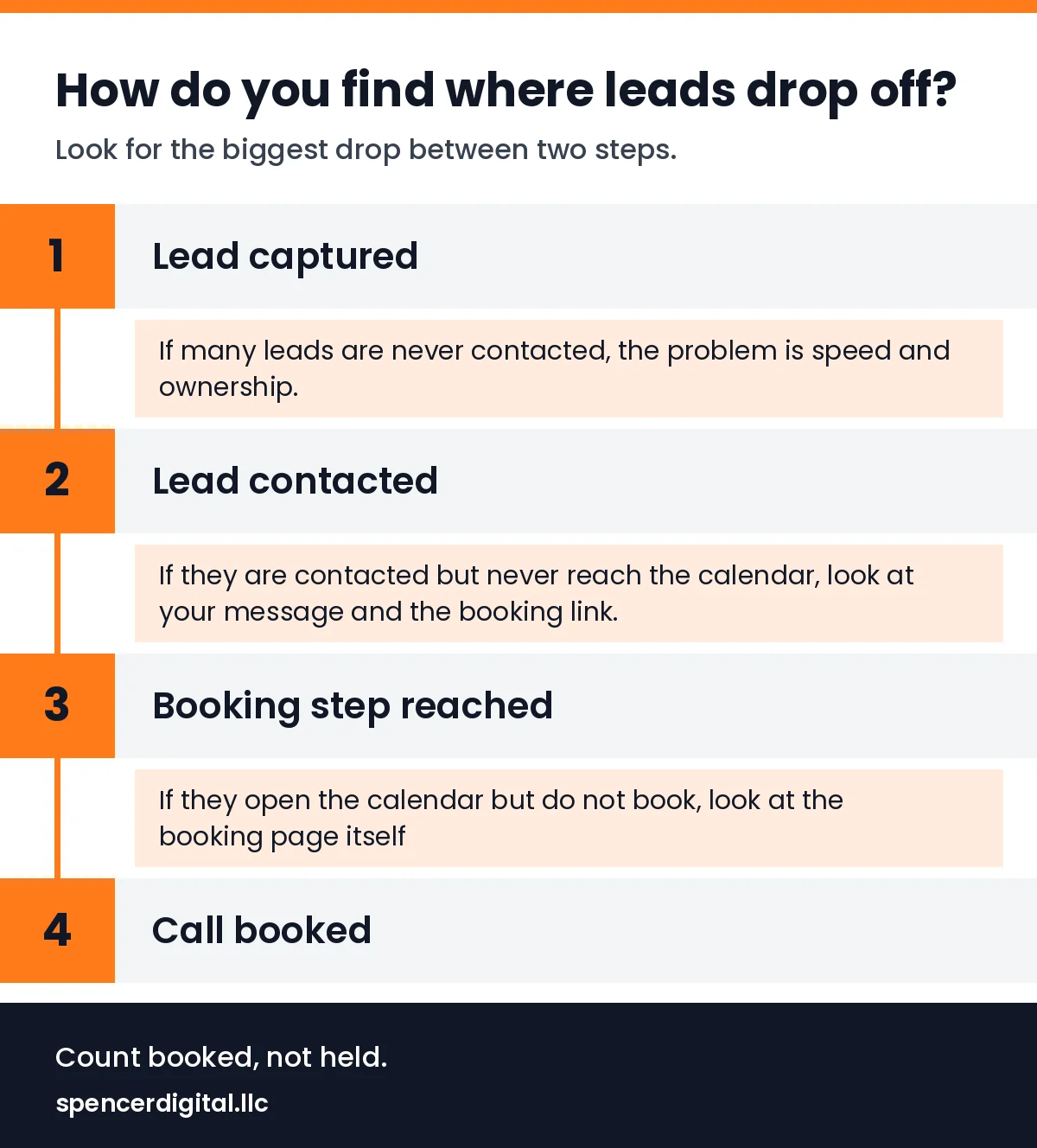
Map the path from the moment someone becomes a lead to the moment a call is confirmed, then count how many people reach each step. A typical path has four steps:
- Lead captured
- Lead contacted
- Booking step reached
- Call booked
Look for the biggest drop between two steps. If many leads are never contacted, the problem is speed and ownership. If they are contacted but never reach the calendar, look at your message and the booking link. If they open the calendar but do not book, look at the booking page itself: too many questions, too few times or a confusing layout.
How does speed to lead affect booked calls?
Speed to lead is the time between a lead arriving and your first real attempt to reach them. Someone who has just filled in a form is thinking about the problem right now. Hours later they are busy, distracted or talking to someone else. A fast, personal reply catches them while the interest is still there.
- Send an automatic confirmation by email and text the moment the lead arrives, with the booking link in it.
- Have a named owner for every new lead and a rule for how soon they make the first call or message.
- Cover evenings and weekends with automation if no one is working, and a person first thing the next business day.
- Measure the time to first contact in your CRM, so you can see whether the rule is being followed.
How should the form and booking step work?
Every extra step between the form and the calendar is a place for people to drop out. The simplest fix is often to put the booking step right after the form, so a lead can choose a time while they are still on the page. Ask only for the details you need to prepare for the call, and keep any qualifying questions short.
- Show the calendar on the thank-you step instead of promising that someone will be in touch.
- Offer enough times across the week, including some early and late options.
- Make sure the page works well on a phone, since many leads arrive from mobile ads.
- Say plainly what the call is, how long it takes and what the person will get from it.
- Test the whole path yourself every time you change the form, the calendar or the ad.
What follow-up keeps leads from going cold?
Many leads will not book on the first touch, and that is normal. A planned follow-up sequence gives them several easy chances to book without anyone having to remember. Decide the sequence once and let the CRM run it.
- Mix channels: a call, a text and an email each reach people in different ways.
- Space the touches over a set number of days rather than sending everything at once.
- Make every message useful, with the booking link and a short reason to talk.
- Stop the sequence as soon as the lead books, replies or asks you to stop.
- Move leads who never respond to a nurture list, with a reason recorded, instead of deleting them.
What should you do about no-shows?
No-shows do not change your lead-to-booked-call rate, but they do waste the bookings you worked hard to win. Send a confirmation right after booking and reminders before the call, make it easy to reschedule, and decide in advance how many times you will try to rebook someone who misses. Track the show rate next to the booking rate so you can see both.
How do you set a target without borrowed benchmarks?
It is tempting to search for an industry average and aim for it. The trouble is that published averages rarely match your offer, price, audience or lead source, and they are measured in different ways. Your own numbers are a better starting point.
- Measure your current rate by source for the last few full months, using the rules above.
- Pick the step with the biggest drop and change one thing, such as response time or the booking page.
- Measure the next cohort with the same window and compare it with your own baseline.
- Keep the change if it helps, then move to the next biggest drop.
If you also want to know whether the problem starts earlier, in the ads themselves, our sister site has a plain-English guide on how to read Facebook ads metrics, and the metric ladder shows how to find the weak step.
Where Spencer Digital fits
Our team builds the paid media and the follow-up systems behind it, because ads only pay off when leads turn into booked calls and sales. That experience includes $150M+ in ad spend managed and $300M+ in career revenue. Alongside paid media, our marketing operations and CRM work covers speed-to-lead automation, booking flows and the reporting that shows your cost per booked call.
If you are deciding whether to bring in help, read when to hire a paid ads agency. When you are ready, see our paid media and marketing operations services or book a free 30-minute strategy call to talk through your numbers with a strategist, with no pressure either way.
Frequently asked questions
What is a lead-to-booked-call conversion rate?
It is the percentage of new leads who book a sales or strategy call within a set window. Divide booked calls from a group of leads by the number of leads in that group, then multiply by 100.
Should no-shows count as booked calls?
Yes, for this rate. A no-show still booked. Track it separately in your show rate, so you can tell a booking problem from a reminder problem.
What is a good lead-to-booked-call rate?
There is no single number that fits every offer, price and lead source. Measure your own baseline by source, improve the biggest drop-off and compare each new cohort with your own past results.
What is the fastest way to raise it?
Start with speed to lead and the booking step: reply quickly with a booking link, and let leads pick a time right after the form. Then add a planned follow-up sequence for anyone who does not book straight away.
Talk it through with a strategist
A free 30-minute call about your goals, scope and a flat monthly rate. No pressure either way.