
Paid media agency for coaches: what to look for
Hiring a paid media agency as a coach is less about platforms and more about whether they can fill your calendar from your offer. Here is what to look for and what to ask.
By Steven Spencer, Founder & CEO, Spencer Digital · Published · Last updated · 9 min read
A paid media agency for coaches should connect your offer, funnel, tracking and follow-up so ads produce booked calls, not only cheap leads. Look for clear ownership of each step, honest reporting against your numbers, and a plan for what happens after someone opts in. Ask how they would run your specific offer before you sign.
Coaches sell high-ticket conversations more often than impulse checkouts. That changes what good paid media looks like. An agency that only optimises for form fills can fill your CRM with names that never book. This guide is a buyer checklist for coaches who are evaluating help: what the agency should own, how that differs from a general ads shop, and the questions that surface a real fit. It is not a when-to-hire readiness test (see when to hire a paid ads agency) and it is not a pricing model explainer (see how flat-rate ad management compares).
What should a coach-focused paid media agency handle?
Start with four areas. If any of them are missing from the pitch, you will end up owning the gap yourself.
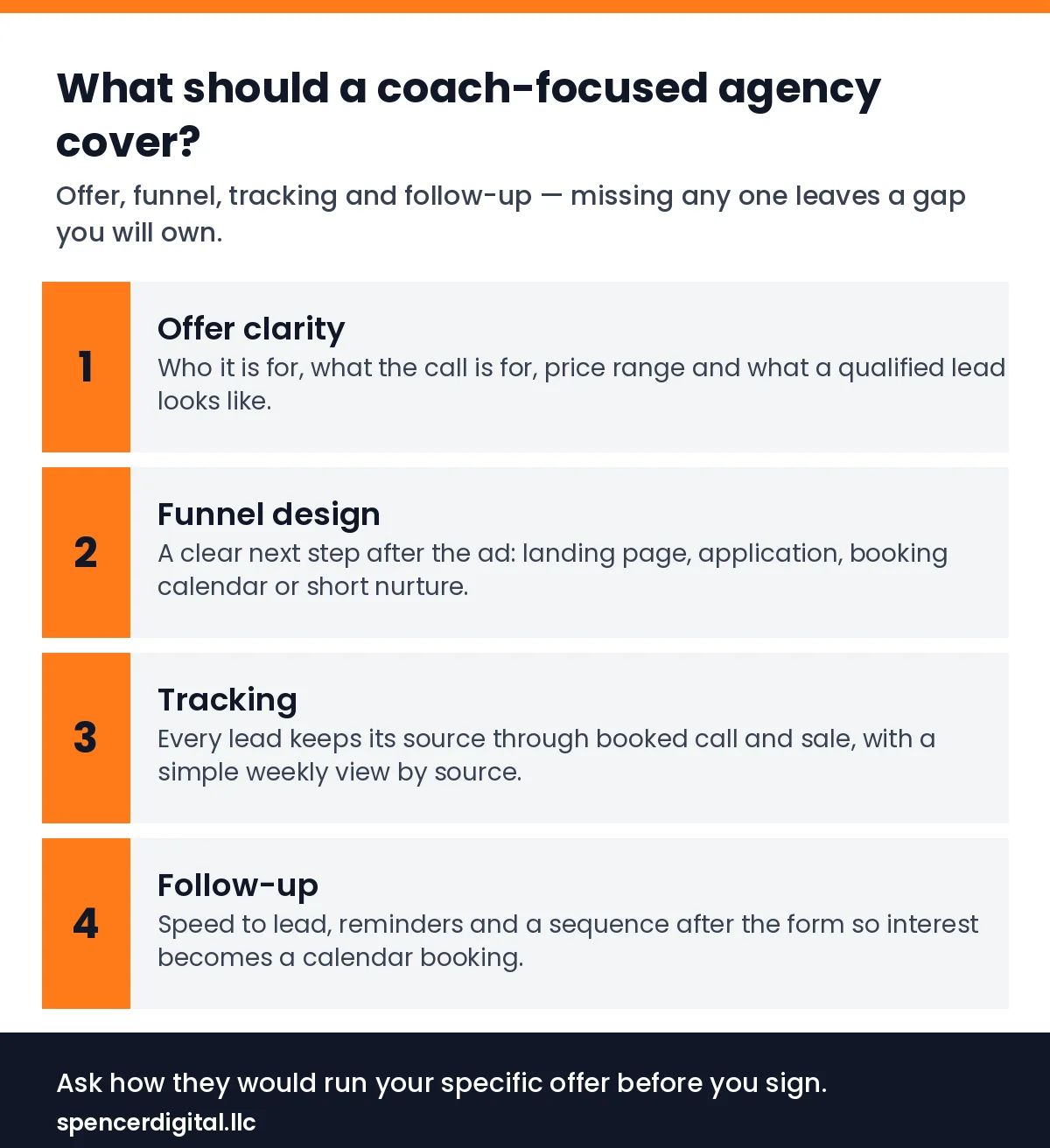
- Offer clarity. The agency should understand who the offer is for, what the call is for, the price range and what a qualified lead looks like. Vague “we run Meta and Google” is not enough.
- Funnel design. Ads need a clear next step: a landing page, an application, a booking calendar or a short nurture. The agency should care about that path, not only the creative.
- Tracking. Every lead should keep its source through to booked call and sale. Without that, you cannot tell which ads pay for themselves.
- Follow-up. Speed to lead, reminders and a simple sequence after the form often decide whether leads book. Ads alone do not close that gap.
If your CRM stages are unclear, fix that alongside the ads. Our guide to CRM pipeline stages for high-ticket sales shows the stage map coaches usually need.
How is this different from a general ads agency?
A general shop may be excellent at ecommerce or local lead gen. Coaching is different because the conversion that matters is usually a booked, held conversation, not a same-day purchase. Cost per lead can look healthy while cost per booked call is not. Ask whether the agency reports on booked calls and show rate, or only on leads and click costs.
Also ask whether they have run offers that sell through applications or strategy calls. The creative, the landing page and the follow-up all change when the “buy” step is a call.
Creative style also differs. Coaching ads often need to speak to a specific pain and a specific transformation, then invite a conversation. Stock lifestyle images and generic “book a call” lines rarely outperform a clear promise tied to your method. A coach-focused agency should be comfortable testing hooks, angles and lead magnets that match how you already sell on sales calls.
What does good tracking look like for a coaching offer?
At minimum you want:
- A conversion event for the lead or application that actually fires when the form succeeds.
- UTM or platform click IDs stored on the lead record.
- A booked-call stage in the CRM that is updated when the calendar confirms.
- A simple weekly view of spend → leads → booked calls → closes by source.
That chain is what lets you raise lead-to-booked-call conversion rate and move budget toward the ads that create conversations. If the agency cannot describe how they would wire that for your tools, keep looking.
Do not accept “the pixel is installed” as the whole answer. Ask them to walk through a test lead from click to CRM stage to calendar event. That ten-minute walkthrough reveals more than a slide about partner badges.
What questions should you ask before you hire?
- How would you define a qualified lead for my offer? Listen for specifics about fit, budget and readiness, not generic demographics.
- Which result do you optimise the ads toward? Prefer booked calls or qualified applications over raw leads when your sales process needs a conversation.
- Who owns the landing page, the form and the booking step? Split ownership is fine if the handoffs are written down.
- How fast do new leads get a reply, and who sends it? Ask for the sequence, not a vague promise.
- What do you report every week? You want spend, results, cost per lead, cost per booked call and what you will change next.
- What happens in the first 30 days? A clear setup plan beats a long brand deck.
- How do you price, and what is included? Compare that with flat-rate vs other agency pricing so scope matches fee.
What should the first 30 days look like?
A practical onboarding for a coaching offer usually covers offer and avatar notes, audit of current tracking, landing or application review, campaign structure, a follow-up sequence and a reporting template. Creative tests come after the path from click to calendar is trustworthy. Launching ads into a broken booking step only creates expensive noise.
When is DIY still the better path?
If your offer, price and calendar are still changing every week, or you cannot yet take more calls, paid media will amplify the mess. Learn the basics first, then hire when volume or complexity outgrows your time. Our sister site walks through running your own ads or hiring an agency and has free Meta and Google Ads training if you want to stay hands-on for now.
How should reporting work week to week?
Ask for a short weekly note, not a 40-page deck. A useful coach-focused report shows spend, leads, cost per lead, booked calls, cost per booked call, show rate if available, and one or two changes planned for the next week. If creative tests are running, the note should say which ads are learning and which are paused. Numbers without a next step leave you guessing.
Agree on the definitions in writing: what counts as a lead, what counts as booked, and the booking window used for the rate. That keeps the agency and your sales team looking at the same funnel.
Where Spencer Digital fits
Spencer Digital runs paid media for offers that sell through calls and applications, including coaching and high-ticket programs. Our work covers the ads and the marketing operations around them: tracking, CRM stages and follow-up. That experience includes $150M+ in ad spend managed and $300M+ in career revenue across performance marketing work.
If you want a second opinion on whether an agency is the right next step, see our paid media and marketing operations services or book a free 30-minute strategy call with a strategist. There is no pressure either way.
Frequently asked questions
What should a paid media agency for coaches actually do?
Connect your offer, funnel, tracking and follow-up so ads produce booked calls. That means clear lead definitions, working conversion tracking, a path to the calendar and reporting on cost per booked call, not only cost per lead.
Is cost per lead enough to judge an agency?
No. For coaching offers that sell on a call, cost per booked call and show rate matter more. Cheap leads that never book raise your true acquisition cost.
Should the agency own my CRM and follow-up?
Someone must own speed to lead and the booking sequence. It can be the agency, your team or a shared plan, but the handoff has to be written and measured.
When should a coach wait to hire?
Wait if the offer, price or calendar is still unstable, or if you cannot take more conversations. Fix those first, then use ads to scale a working path.
Talk it through with a strategist
A free 30-minute call about your goals, scope and a flat monthly rate. No pressure either way.